What We Believe Needs to Change – and What We Can Do About It
Football is at a crossroads.
In an era that prides itself on progress, this is uncomfortable – but the current direction of travel risks draining the game of its joy, its creativity, its intelligence and its purpose. The elite game is shaped and influenced by the decisions being made by governing bodies, leagues, media companies, club owners, commentators, managers and players.
The unintended consequence of these decisions affect the everyday experience of children playing football across the world. At the moment, the effects are not positive.
Those of us who work in the game have a responsibility to say this clearly.
It’s been a while since football has faced a moment like this. For the first time, large numbers of people who grew up loving the game are openly longing for how football used to feel. Previous generations did not look at the stars of their time and see decline. My father’s generation didn’t watch Bryan Robson, Kenny Dalglish, Ian Rush or Maradona and believe they were inferior to Moore, Beckenbauer Charlton or Best.
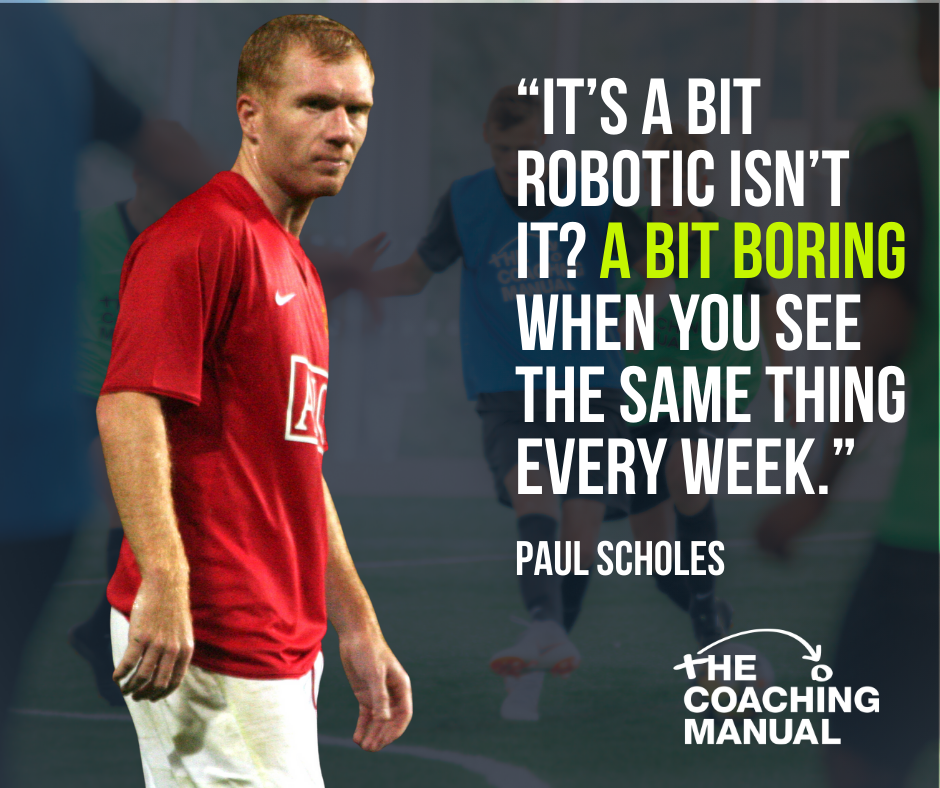
Today, more and more former professionals are saying the same thing: football has become predictable, controlled, and increasingly boring.
The problem is this: the malaise at the top of the game is already affecting the grassroots. What is normalised, rewarded, and celebrated in elite football always filters down. When the professional game becomes mechanical, the joy at the bottom begins to disappear too.
History tells us this is not inevitable. The last time football became this predictable - to the point where it risked losing the viewing public – the pass back rule was introduced. The game intervened because it had to. Football has adapted before, and it can adapt again.
But only if we are honest about the causes.
The Problem Isn’t People — It’s Systems
One of the most significant changes in modern football is the decline of the adult 11-a-side game across much of Europe. Fewer people now spend their early adult years playing football wiith players of various ages, abilities and temperaments. This matters more than we often admit.
While small-sided and recreational formats have value, they do not replicate the complexity, chaos and collective problem-solving of adult 11v11 football. As a result, many new coaches are entering the game with less lived experience than any generation before them – despite having unprecedented access to matches, clips, analysis and content.
Watching football is not the same as living it.
Lived experience builds a type of knowledge that cannot be fast-forwarded, downloaded or explained away. In its absence, coaching increasingly gravitates toward what is easiest to measure and control: physical outputs, technical actions, tactical structures.
What is easiest to measure, however, is rarely what matters most.
When education is driven by metrics, and metrics drive behaviour, football becomes mechanical. We end up training players to satisfy systems rather than solve problems. Organisation replaces understanding. Compliance replaces curiosity.
When Play Decreases, Intervention Increases
As informal play has declined, adult intervention has increased. These trends are not accidental.
There was a time when most adults teaching football had spent twenty or thirty years inside the game. Because of that experience, they didn’t feel the need to intervene constantly. They trusted football to teach football.
Today, many adults arrive in the game with far less lived experience. This is not a personal failure – it is a structural one. But in the absence of experience, certainty becomes attractive.
- Instead of asking “what is happening in front of me?”, adults ask “what am I supposed to see?”
- Instead of trusting judgement, they follow scripts.
- Instead of allowing players to solve problems, they intervene to protect the plan.
This is how indoctrination happens — quietly, with good intentions but with poor outcomes.
The tragedy is that the more adults intervene, the fewer opportunities players have to develop the judgement those adults lack. The cycle feeds itself.
Why Certainty Is Seductive
Certainty feels like competence.
In a chaotic game like football, certainty simplifies complexity. It offers safety, language, and protection from doubt — especially for those without deep lived experience. Frameworks, philosophies and predictable patterns provide answers in advance. They remove the need to interpret the moment.
Certainty also brings status. Clear rules and confident opinions travel well. They sound authoritative. They are easy to repeat, defend, and justify — particularly when wrapped in data or jargon.
Uncertainty, by contrast, sounds weak:
“I’m not sure.”
“Let’s see what happens.”
“What did you notice?”
Yet football does not reward certainty. It rewards perception, adaptability and timing.
The danger is not structure itself, but when structure hardens into dogma. What begins as guidance becomes law. What begins as support becomes interference. And the players pay the price.
Judgement Over Dogma
Judgement over dogma is what happens when twenty kids are down the park without an adult in sight.
No scripts. No philosophies. No touchline corrections every five seconds. Just problems to solve, teams to balance, arguments to settle, and space to exploit.
Players learn when to play short because pressure is light.
They learn when to go long because the opposition are high (or the keeper got bored and came up for a corner).
They learn when to dribble, when to combine, and when to slow the game down — not because someone told them to, but because the game demanded it.
Dogma enters when adults replace perception with rules:
- Always play out
- Never go long
- Always press
- Pass here, then here, then here
These rules look organised, but they strip football of its intelligence.
The aim is not to produce players who always choose the same solution. It is to produce players who understand why they are choosing it.
The Role of Commentary, Media and Social Platforms
Football culture is shaped not just on training pitches, but through the voices that frame the game every day.
Modern commentary often presents football as healthier than it is. On television, matches are relentlessly talked up. Organisation is praised as intelligence. Safety is mistaken for control. Mediocrity – by elite standards – is framed as modernism.
Yet away from the broadcast, the tone changes.
The same commentators who reassure the public that everything is “hunky-dory” will admit on podcasts, panels and private conversations that the game has become repetitive, predictable, and less expressive — and that many modern players would struggle to stand out in teams from fifteen or twenty years ago.
This contradiction matters.
When the public conversation refuses to be honest, stagnation is normalised. When difficult truths are softened, nothing changes. And when critique is dismissed as nostalgia or bitterness, serious debate is quashed.
Social media accelerates this problem.
Platforms reward confidence over curiosity, certainty over doubt. Language becomes shorthand. Complex ideas are flattened into phrases that sound insightful but explain very little:
- “If you want players to have more time, teach them to scan.”
- “Press, press, press.”
- “The system failed them.”
AI now magnifies this effect. It allows people to sound knowledgeable without earning understanding. Posts can be generated, terminology replicated, and authority performed – without the lived experience that gives ideas meaning.
This performed authority is then taken on by coaches and parents who do not yet have the lived experience to challenge it. Gradually, inaccurate or incomplete ideas harden into accepted truth.
The danger is not technology itself. The danger is when football knowledge becomes something that can be performed rather than developed.
When jargon replaces insight, dogma spreads faster. Coaches inherit language before judgement. Ideas become rules before they are understood. And the gap between how football is talked about and how it is actually experienced grows wider.
If we want football to evolve, we must be more honest – on screen, online, and in education. The game does not need more certainty in its language. It needs more humility.
What We Stand For
Football must urgently rebalance itself.
In 2026, the game needs less obsession with what is measurable and more commitment to what is meaningful – because the things that made people fall in love with football were never easily quantified.
The magic of the game has always lived in moments that couldn’t be scripted.
We believe football must place greater value on:
- Vision – seeing possibilities others don’t, spotting solutions before they fully exist
- Courage – taking risks without fear of punishment or embarrassment
- Responsibility – solving problems together, without waiting for instructions
- Freedom – learning through consequence, not control
- Judgement – understanding when and why, not just what
These are not abstract ideals. They are the foundations of joy.
When players are trusted to see, decide and adapt, football becomes expressive again. When judgement replaces instruction, creativity returns. When freedom replaces fear, the game feels alive.
Football is a thinking game before it is a running game.
And it is at its best when it feels like it belongs to the players.
.png?width=940&height=788&name=Johann%20Cruyff%20(1).png)
What Grassroots Coaches Must Do
If football is losing its joy, it isn’t because of children. It is because of us grown ups.
The only people who can truly take joy out of football for children are adults — and when those adults are uneducated, insecure, or overly controlling, that joy evaporates like a raindrop in a desert.
Grassroots coaches may not control elite football, but they do control the environment they create. That environment shapes how children experience the game – often for life.
That responsibility does not disappear because someone is inexperienced.
1. Learn the Game — Properly
Coaching football requires more than enthusiasm and good intentions. It requires understanding.
If you have not played adult football, you must actively seek understanding elsewhere. Speak to people who have lived the game. Watch matches with the intent to understand why things happen, not just what happens. Be sceptical of quick answers and fashionable ideas.
Football at grassroots level is not a television product. Do not coach what you see on TV unless you understand the context (and level of ability required) that makes it work.
Curiosity, humility and patience are non-negotiable.
2. Teach the Game, Not the Diagram
If your session relies on fixed positions, rehearsed patterns, or constant stoppages, you are teaching compliance, not football.
Design sessions where:
- players must make decisions
- problems change
- multiple solutions are possible
Let players play before you explain. Use the game as the teacher and your voice as the guide – not the other way around.
3. Create Consequences Without Fear
Players only learn when actions have consequences. Fear kills that process.
Do not protect players from the outcome of their decisions. Protect them from humiliation.
Allow mistakes to matter within the game, then help players reflect on why they happened. This is how understanding grows.
If players are afraid of your reaction, they will stop thinking for themselves.
4. Coach Judgement, Not Instructions
Do not replace one set of rules with another.
Your role is to help players recognise cues:
- pressure and time
- space and numbers
- risk and reward
Sometimes playing short is right. Sometimes going long is right. Sometimes the best decision is to wait.
If players cannot explain why they chose an action, they are guessing or copying — not deciding.
5. Talk Less. Ask Better Questions.
Constant instruction creates dependency.
Use questions to guide thinking:
- What did you see?
- What changed?
- What other options were there?
Silence is not neglect. It is space for learning.
If you can’t explain an idea simply, you don’t understand it well enough yet. Do not teach what you don’t understand.
6. Value Intangibles as Much as Outcomes
If you only praise goals, results and physical effort, those will become the only things that matter.
Actively recognise:
- courage to try
- awareness of others
- problem-solving under pressure
- responsibility for teammates
What you praise shapes behaviour. Choose carefully.
The Line We Must Not Cross
At grassroots level, football should never feel like a job, a performance, or a constant evaluation. The moment it does, the joy drains away – quietly and often permanently. For you and for your players.
Our task is not to replace the park with a programme.
It is to protect the conditions that made the park such a powerful teacher.
If we do that, the football will take care of itself.
.png)